What are Stamp Duty and Registration Charges in Noida and GST Charges on a Flat (2026 Guide)
Short answer: In Noida, a male buyer pays 7% stamp duty and 1% registration on the value of the flat. A woman who is the sole owner pays 1% less stamp duty on property up to ₹1 crore. GST is usually 5% on an under-construction flat and usually nil on a ready flat with an occupancy certificate.
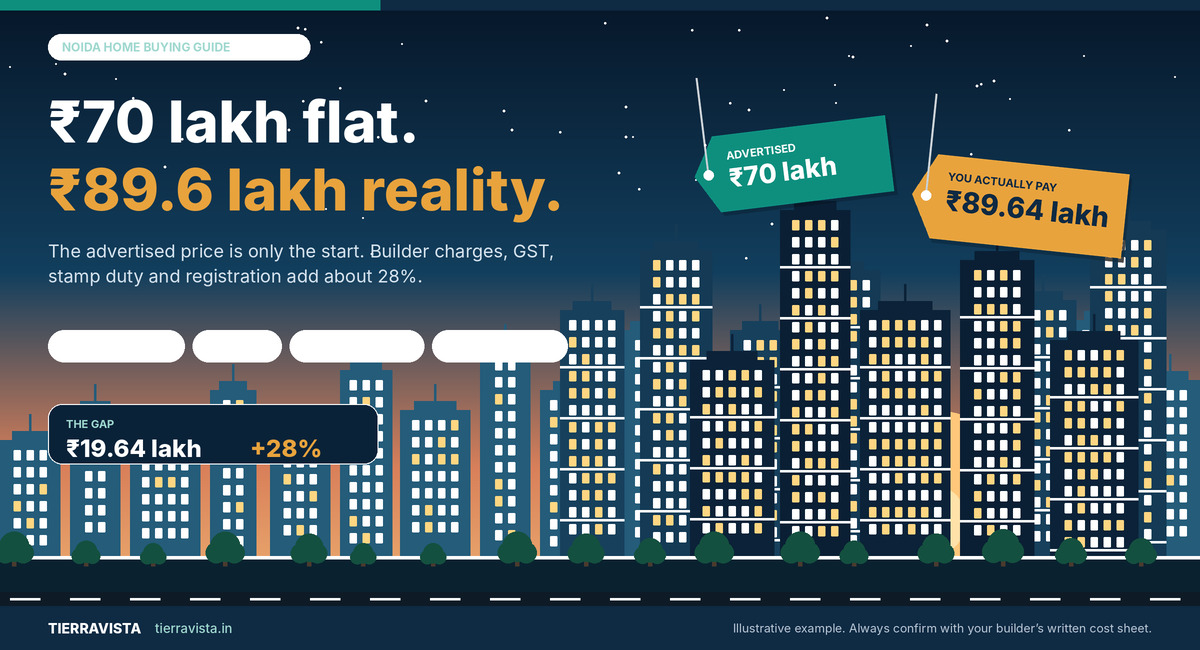
Most buyers compare flats by price per square foot and forget the charges that come after it. For a man buying an under-construction flat, stamp duty, registration, and GST add up to about 13% of the agreement value. That is 7% + 1% + 5%, as long as the circle rate is not above the price. It is a big amount, so it is better to know it before you book. This guide explains the stamp duty and registration charges in Noida and the GST on a flat in plain words. It also shows a worked example. The same state rules apply in Noida and Greater Noida, because both are in Uttar Pradesh. Builder charges differ from project to project.
At Tierravista, our aim is to give home buyers honest information. Every number below is either a rule or a clearly marked example. None of it is a promise about your flat.
Key Points
- A male buyer pays 7% stamp duty and 1% registration. A woman who is the sole owner pays 6% stamp duty on property up to ₹1 crore.
- Both are charged on the higher of your price or the circle rate.
- GST on a flat purchase is usually 5% for an under-construction flat (1% for affordable housing) and usually nil for a ready flat with an occupancy certificate.
- In new projects, stamp duty may be due earlier than you expect. Ask the builder when.
- Ask for the full cost sheet in writing before you pay any booking amount.
How much are the stamp duty and registration charges in Noida?
Stamp duty and registration are government fees for recording the flat in your name. You pay registration and stamp duty to the state, and both are a percentage of the flat’s value. The registration charges for a flat are 1% for every buyer.
| Buyer | Stamp duty | Registration |
|---|---|---|
| Man | 7% | 1% |
| Woman (sole owner) | 6% on property up to ₹1 crore* | 1% |
How the value is decided: Both charges apply to the higher of two values. One is the price in your agreement. The other is the circle rate. So even if you negotiate a lower price, you may still pay on the circle rate.
Note: In July 2025, the Uttar Pradesh cabinet raised the limit for the 1% women’s rebate from ₹10 lakh to ₹1 crore. The most you can save is ₹1 lakh. Some websites still show the older ₹10,000 figure. Rates for joint ownership are also shown differently on different sites. Before you register, confirm the exact rate on the official IGRS UP portal or with the Sub-Registrar office.
When Do You Pay the Stamp Duty and Registration in Noida?
In the past, buyers paid stamp duty when the builder handed over the flat. That is changing in new projects. News reports say the authorities in Noida, Greater Noida, and Yamuna Expressway now ask builders to register an agreement to sell. This happens once you have paid 10% of the cost. They also say stamp duty is paid at that stage. A separate possession deed is signed at handover.
The timing can differ by project and by authority. Ask the builder in writing when stamp duty and registration are due, and confirm with the sub-registrar office.
What is the circle rate in Noida?
The circle rate is the minimum value the government sets for property in an area. Registration offices use it as a floor, so duty is never worked out on less than this value. The circle rate in Noida differs by sector and by type of property, and it changes when the government revises it.
Example: A flat’s circle-rate value is ₹80 lakh, but you agree on a price of ₹75 lakh. Then you pay stamp duty and registration on ₹80 lakh. To find the circle rate in Noida for your sector, you have to check the IGRS UP portal or ask at the Sub-Registrar office.
How Much GST on Flat Purchase in Noida?
GST on the purchase of a new flat depends on the stage of the flat, not on the city. The GST rate on a flat purchase is set at the national level, so it is the same in Noida as anywhere else in India.
- GST on a new flat purchase (under construction): usually 5%. For affordable housing, it is usually 1%.
- GST on a ready flat with an occupancy certificate: usually nil. But an occupancy certificate (OC) is a paper from the authority that says the building is fit to live in.
- GST on a resale flat: generally nil, because the building is already complete.
The builder adds GST to your bill. GST in a flat purchase is normally charged on the total agreement value, not only the basic price. It is not charged on stamp duty or registration. But some websites apply the 5% to only two-thirds of the price. So, ask the builder to show how the GST was worked out on the cost sheet, and confirm with a CA or on the GST portal. Because the rates can change, check the current rate when you book. And also ask if the quoted price already includes GST. Some “all-inclusive” prices don’t.
Example: stamp duty, registration charges for flat, and GST on a ₹70 lakh flat in Noida
This is the only example. May your builder’s numbers be different.
Here is an under-construction flat advertised at ₹70 lakh, bought by a man:
| Item | Amount (₹) |
|---|---|
| Basic price (as advertised) | 7,000,000 |
| PLC | 300,000 |
| Covered parking | 300,000 |
| Club membership | 100,000 |
| Power backup and other builder charges | 100,000 |
| Agreement value | 7,800,000 |
| GST at 5% | 390,000 |
| Stamp duty at 7% (assuming the circle rate is lower than the agreement value) | 546,000 |
| Registration at 1% | 78,000 |
| IFMS deposit | 100,000 |
| Legal check and other costs | 50,000 |
| Total you pay | 8,964,000 |
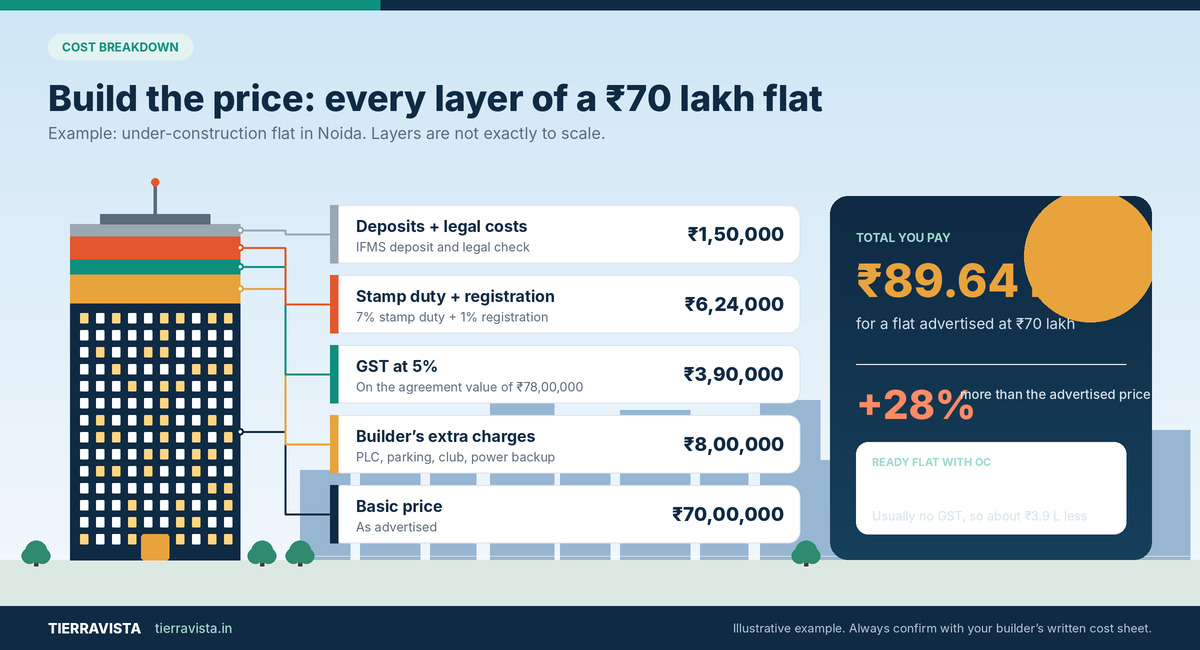
What this shows?
Stamp duty, registration, and GST together come to ₹10.14 lakh. That is 13% of the agreement value. With the builder’s extra charges and other costs, the ₹70 lakh flat costs about ₹89.6 lakh. That is about 28% more than the advertised price. If the same flat were ready to move with an occupancy certificate and no GST, the total would be about ₹85.74 lakh. If a woman is the sole owner and the property is under ₹1 crore, stamp duty at 6% would save ₹78,000 in this example.
What does the builder charge on top of the basic price?
The builder’s price has more than one line. Ask for all of them in one cost sheet.
| Charges | What does it mean | What have to ask |
|---|---|---|
| Basic sale price (BSP) | Rate per sq.ft multiplied by the area | Is the rate on carpet area or super area? |
| PLC (preferential location charge) | Extra for a “Better” flat, such as a park view or a lower floor | What makes my flat “preferred”? |
| Parking | Covered or open parking slot | Is the slot fixed to my flat in writing? |
| Club membership | Access to the society club | Is it compulsory? |
| Power backup | Connection for generator backup | How many kVA, and what is the monthly rate? |
| IFMS (interest-free maintenance security) | A deposit held for future maintenance | Who holds it, and when does it go to the residents’ association? |
Tip: Compare projects on the carpet area price, not the super area price. Because the carpet area is the area inside your flat’s walls. It is also the area that is shown on the RERA (Real Estate Regulatory Authority) record. and it registers projects in each state.
What are the other Costs that First-Time Buyers Should Plan For?
- Check the legal documents with a lawyer
- Check the home loan processing and valuation fees, and loan insurance if you take it
- Check the maintenance advance if the builder asks for it
- Check the authority charges, such as lease or transfer charges. Ask if any apply to your flat. and brokerage, if any. Ask who pays it and get it in writing.
- Moving, interiors, and furniture
What are the Checklist to ask the builder in writing?
- A full cost sheet with every charge on one page
- How GST is worked out and whether it is included in the quoted price
- The stage at which stamp duty and registration must be paid
- The circle rate for your sector
- The area used for pricing (carpet area and super area)
- The reason your flat has a PLC
- Where the IFMS and maintenance deposit are held, and the refund terms
- The payment schedule with dates
- The project’s RERA number, checked on the UP RERA website
What are the 5 Common Mistakes When Budgeting for a Flat?
While budgeting for a flat, purchasing many buyers do the common mistakes.
- Planning from the advertised price. Have to plan from the total, not the headline.
- Forgetting the circle rate. Because the stamp duty can be higher than you expect.
- Assuming that the stamp duty is due only at possession. In new projects it may be due earlier. So ask.
- Paying a booking amount before seeing the cost sheet. Ask first, then pay later.
- Believing “all-inclusive” means everything. Ask what is included and what is not.
How to plan your budget in 3 steps?
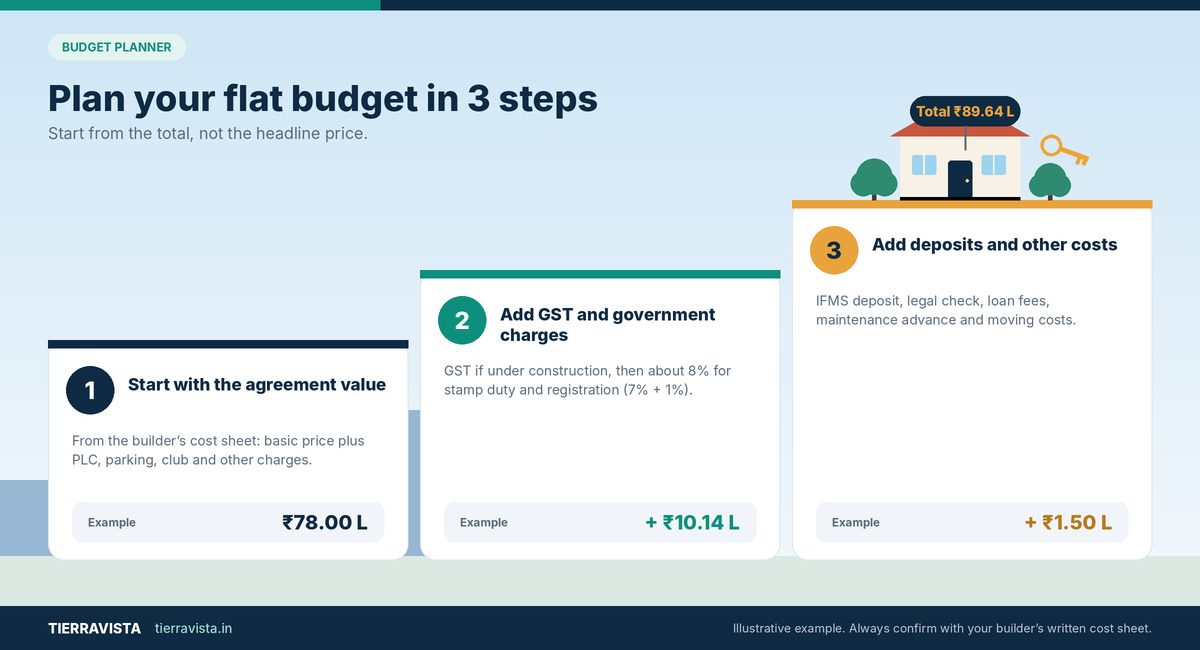
- First you have to start with the agreement value from the builder’s cost sheet.
- Add GST if the flat is under construction. Then add about 8% for registration and stamp duty (7% + 1%). It is a little less for a woman sole owner. Keep this money ready early, because it may be due when the agreement to sell is registered.
- Add the deposits and other costs from the list above.
Note: A builder’s extra charges are not a predictable or fixed number, because they can differ from project to project. That is why the written cost sheet matters.
How About Buying as an NRI?
You can pay through your NRE or NRO account. Tax rules for payment and for sale are different from those for residents. Read our NRI investment guide .
Sources to check for Gst rate on flat purchase
- IGRS UP for stamp duty, registration, and circle rates
- UP RERA for project registration
- GST portal for current GST rates
Disclamer: This guide is general information, not legal or tax advice. Rules and rates can change, so confirm the latest details with official sources or a qualified professional before you buy.
Frequently Asked Questions:
What are the stamp duty and registration charges in Noida?
A male buyer pays 7% stamp duty and 1% registration. The registration charges for a flat are the same 1% for every buyer. A woman who is the sole owner pays 6% stamp duty on property up to ₹1 crore, with a maximum benefit of ₹1 lakh. Both are charged on the higher of the agreement price or the circle rate. Confirm the current rates on the IGRS UP portal.
What are the registration fee and stamp duty for a flat in Greater Noida?
They are the same as in Noida, because Uttar Pradesh sets the rates. The circle rate can differ by area, so check the rate for your sector or village.
Do women pay less stamp duty in Uttar Pradesh?
Yes. A sole female owner gets a 1% concession on property up to ₹1 crore, with a maximum benefit of ₹1 lakh. Confirm the current rate on the IGRS UP portal before registration.
Is GST charged on a ready-to-move or resale flat?
GST is usually nil on a ready flat with an occupancy or completion certificate, and generally nil on a resale flat. Check this for your specific flat.
What are PLC and IFMS?
PLC is a preferential location charge. It is extra money for a flat the builder calls “better,” such as one with a park view. IFMS is interest-free maintenance security, a deposit kept for future maintenance. Ask who holds it and what happens to it when the residents’ association is formed.
Can the builder add new charges after I book?
The agreement should state the price and what it covers. Ask for every charge in writing before you pay the booking amount, and have a lawyer read the agreement.
Talk to Tierravista For a Free and better Consultancy
Have a cost sheet you want a second pair of eyes on? Contact us.